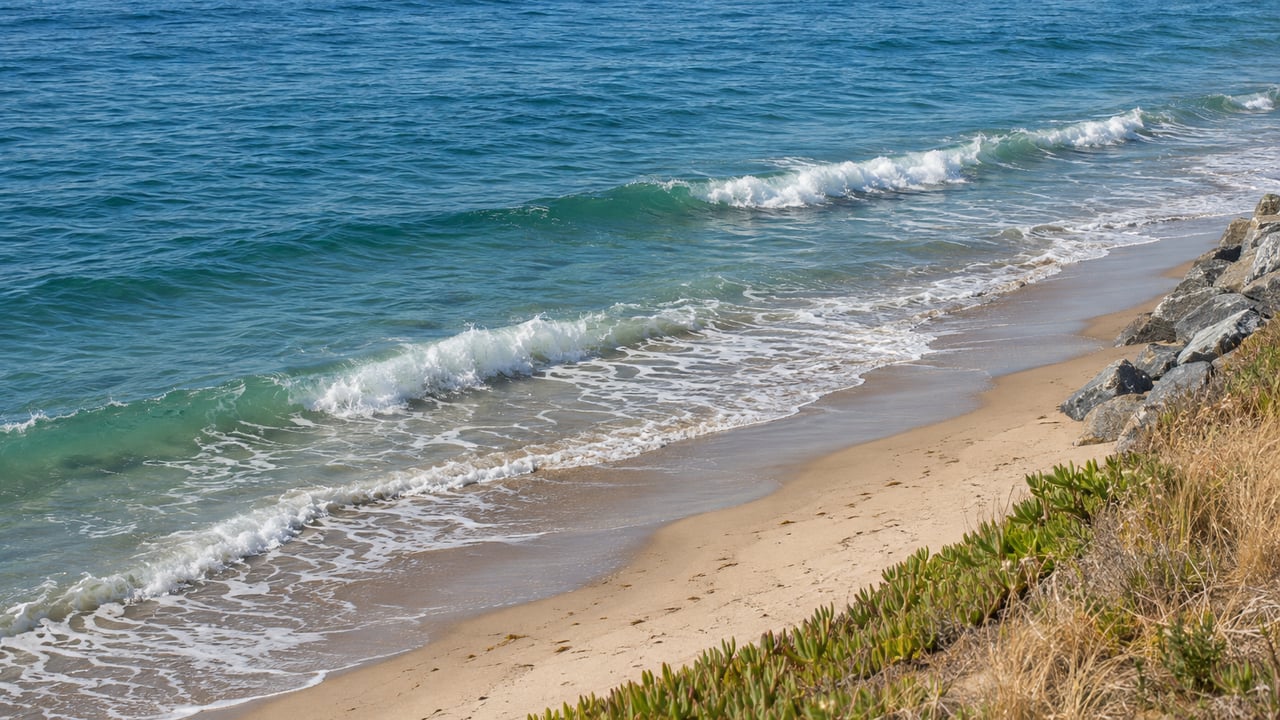
On November 3, San Clemente voters turned down a local sales tax that would have paid for beach sand. Two days later, the California Coastal Commission approved a permit for almost 700,000 cubic yards of sand on the same coastline. Orange County officials call it the largest sand replenishment on this stretch in more than 60 years, according to the Los Angeles Times.
Together, the vote and the permit show who is now responsible for San Clemente's beaches. Most of the sand this town gets over the next year is being bought to protect the coastal rail line. It will land where the tracks need it, on a schedule set by permits and dredging equipment, and the city's own budget is a small part of the total.
What voters turned down
Measure M was a citizen initiative for a one-percentage-point local sales tax that would have run for 10 years. The city estimated it would raise about $15 million a year. Half would have gone to a restricted Beach Protection Fund and half to a fire protection and wildfire preparedness fund. At least 70% of the beach half had to be spent on sand replenishment, retention and erosion control. That works out to about $7.5 million a year of dedicated beach money, for a decade, controlled locally.
Because it was a citizen initiative, Measure M needed only a simple majority, as the city's resolution sets out. The 2024 attempt, Measure BB, was a city-sponsored half-cent tax that needed two-thirds and narrowly missed, according to the San Clemente Times. The lower threshold made no difference. In the Orange County Registrar's unofficial count as of November 7, the measure had 17,133 No votes (63.06%) and 10,038 Yes votes (36.94%), with all 36 precincts reporting.
The name can be confusing. The rail program now funding the sand draws partly on a different Measure M: Orange County's Measure M2 transportation sales tax.
City Hall is working with about $2 million for North Beach, half of it from the state
Without a dedicated tax, City Hall is working from a one-time amount. In September, the City Council told City Manager Andy Hall to use $1 million in city funds to get as much sand as possible for North Beach at the lowest cost. A week later, Sen. Tony Strickland secured another $1 million in state funding, according to the Orange County Register.
How much sand that buys depends mostly on where it comes from. Mayor Rick Loeffler told the Register that sand from the Prado Dam would be free and quarry sand would cost money, and that trucking is the more expensive part either way. He said he hopes sand placed at North Beach will "migrate toward Capistrano Shores." The city's September coastal plan also listed a fall 2026 project of about 5,000 cubic yards of quarry sand to build winter berms.
North Beach has had trucked sand before. The San Clemente Times covered an earlier OCTA placement there of about 3,400 cubic yards hauled from a Palm Springs quarry. That's the scale trucks can deliver. The next delivery planned for that same stretch is about 70 times larger.
OCTA's rail program is far larger, and it needs a ship
OCTA's coastal rail emergency program is estimated at $310.5 million, funded through Measure M2 along with state and federal money. Its purpose is to keep the tracks open where they run along the beach. The planned sand volume grew from about 540,000 cubic yards to 690,000 after the agency's fall emergency action. Voice of OC reported how it splits: 240,000 cubic yards between North Beach and Mariposa Point, and 450,000 cubic yards at San Clemente State Beach.
Here is how the sources line up after the November 5 permit vote:
| Source of sand | Where it goes | Approximate volume | Timing |
|---|---|---|---|
| City of San Clemente, with $1M city and $1M state funds | North Beach | Depends on sand source and trucking cost | Sand source still being chosen as of late September |
| City fall berm project | Winter berms | About 5,000 cubic yards | Planned for fall 2026 |
| OCTA coastal rail emergency program | North Beach to Mariposa Point | 240,000 cubic yards | As early as January; earlier schedule said February to June 2027 |
| OCTA coastal rail emergency program | San Clemente State Beach | 450,000 cubic yards | Same window |
| U.S. Army Corps of Engineers shore protection project | Citywide plan | Nearly 2 million cubic yards | Over 50 years |
| SANDAG Regional Beach Sand Project III | Regional | About 1 million cubic yards | Separate regional effort |
On timing, the Los Angeles Times reported that about $300 million in state and federal funding has been secured to protect the four miles of coast where the railroad is most exposed. Supervisor Katrina Foley, who sits on the OCTA board, said the replenishment would use about a third of that and could begin as early as January. At the Coastal Commission hearing she said, "Sand on the beaches is the solution."
The limiting factor is equipment. An OCTA spokesperson told Voice of OC that "there are few U.S.-qualified hopper dredges capable of performing this work, and many are committed to projects months in advance." The agency was working to bring a dredge down from Oregon. OCTA's October presentation had the work starting in February 2027 and finishing in June 2027, subject to permits and equipment. The permit was approved on November 5. The dredge is now what determines whether sand arrives in January or in the spring.
The same Voice of OC report noted that OCTA also plans an "engineered shoreline protection structure," starting in February 2027 and finishing in February 2028.
The trail and the pier, before the sand arrives
The rail program has already changed one part of the beach. On October 9, OCTA reopened the San Clemente Beach Trail at Mariposa Point. A landslide in January 2024 had destroyed the city's pedestrian bridge there and cut the trail. The roughly $93 million project, which began in September 2025, built a catchment wall of nearly 1,400 feet to keep bluff debris off the tracks, and it rebuilt the walking path next to it, according to OCTA's announcement. The trail is open again, while the sand in front of it is still waiting on the dredge.
The pier is in a similar position. An engineer's inspection found it structurally sound, and Mayor Loeffler told the Orange County Register that this made sand the city's spending priority over pier maintenance. According to the San Clemente Times, the pier is safe for pedestrians and maintenance vehicles despite losing a pylon and 17 braces. Heavier vehicles are restricted, and repairs are expected in the spring after the winter king tides. The same report said crews have repeatedly pumped water out of beach-access underpasses.
The city's longer-term work is about keeping sand in place
Since the tax failed, the city's most distinctive project is a study, and it is aimed at keeping sand on the beach once it has been placed. In September, city staff planned to use a $2 million State Coastal Conservancy grant, which requires no local match, for Phase 2 planning of a North Beach sand-retention pilot. The study runs from 2026 through 2029, with completion planned by December 2029. One option under review pairs an offshore rocky reef at North Beach with about 500,000 cubic yards of sand. The city has not chosen a project.
That split is likely to define the next few years. Regional, state and federal agencies are paying for the volume, mainly because the railroad depends on it. The city's role is to find a way to make that sand stay, using grant money, while voters have now turned down a dedicated local beach tax twice in two years.
If you're weighing how North Beach, the Mariposa Point stretch or the area near the State Beach fits your plans while this work is underway, Shaun Hurley Homes can walk you through what's scheduled near a specific address and what's still open. Schedule a confidential consultation.
